Cerne Abbey Research Project
Founded in AD987 by Æthelmaer the Stout on the site of an earlier Christian community, Cerne Abbey grew to become one of the most important monasteries in the South West of England. Shortly after its closure during the Dissolution in 1539 the site was comprehensively demolished save for a gatehouse, and the precise location of its buildings lost until archaeological work started in 2022.
NEW FEATURE-LENGTH TIME TEAM EPISODE!
Cerne Abbas: Secrets Beneath The Giant
-
The 2026 excavation season is now over.
Details concerning further work in 2027 will be released in the new year.
-
The 2026 season is now over.
-
Accommodation is camping, with personal tents and cot beds provided upon request. The project will also provide all food and there will be a hot shower and portaloos on site.
-
Applications for the 2027 season will open in the new year.
-
For further details or if you have any questions please email Dr Hugh Willmott
The abbey sits at the feet of the famous chalk-cut figure of a club-wielding giant that dominates the village of Cerne Abbas. Recent dating of the figure by the National Trust has shown that the giant was an Anglo-Saxon creation, and it seems directly connected to the earliest monks residing there. Ground Penetrating Radar (GPR) survey undertaken by the University of Sheffield provided the first ever evidence for the medieval abbey, and potentially its Anglo-Saxon predecessor beneath. Not only did it reveal an amazingly clear plan of the cloistral ranges, the survey showed that the buildings remained surprisingly intact with walls up to four feet tall in places.
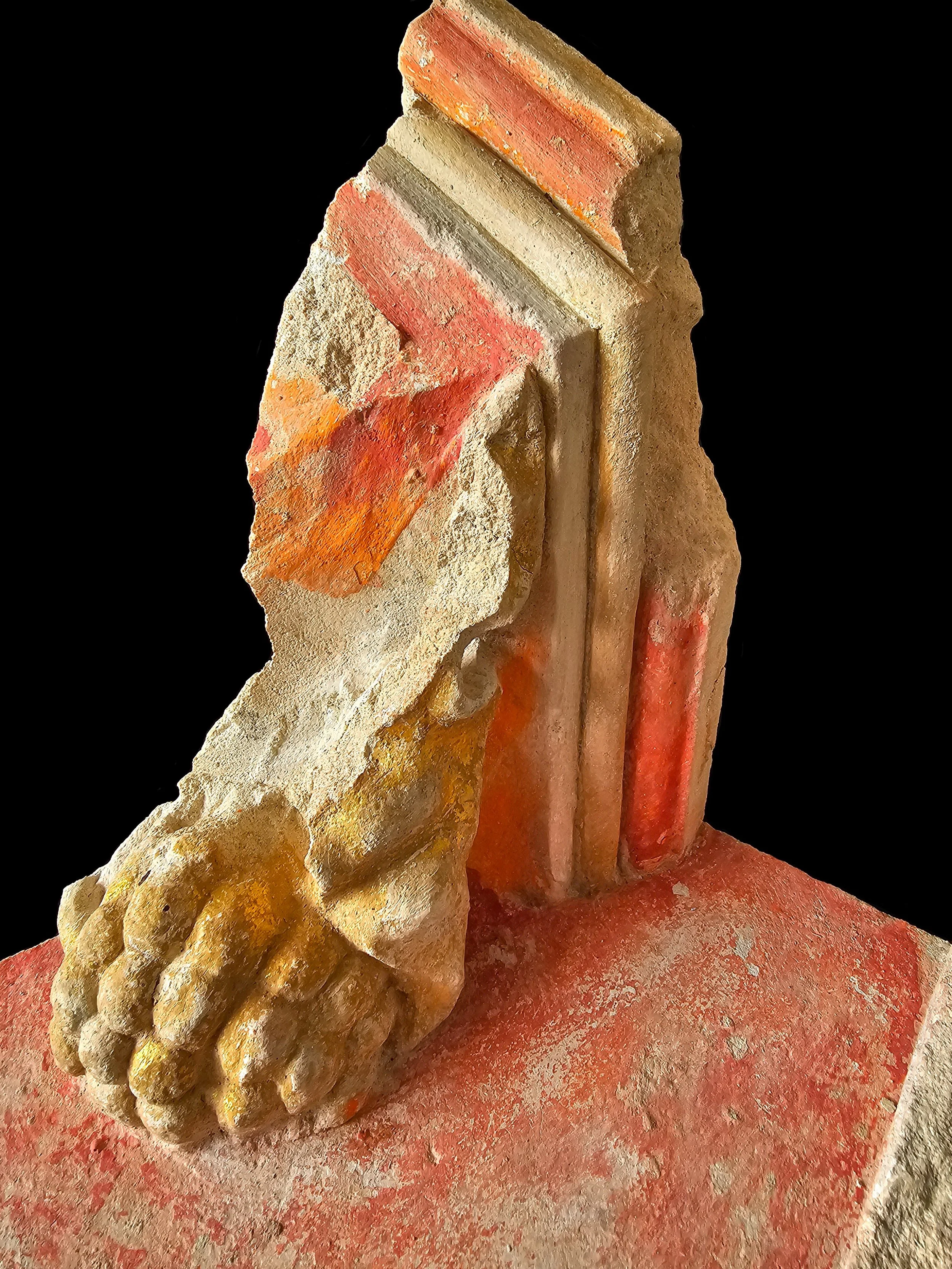
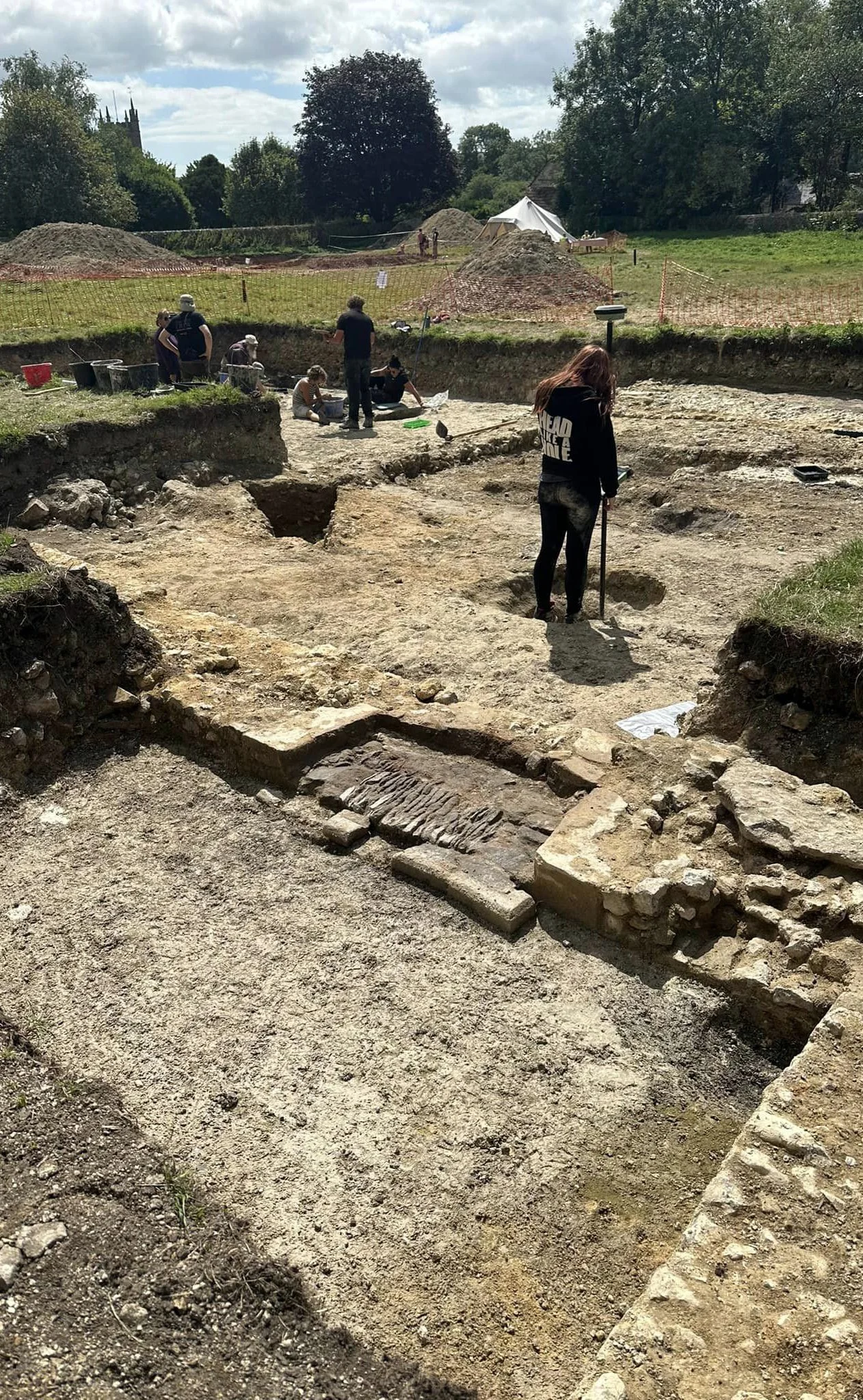
Excavations in 2023 started to investigate these results, with a trench located over the southwest corner of the cloister, which includes part of the west range and the north aisle of the monastic church. Although heavily robbed, our work revealed evidence for decorative tiled floors and even an intact burial in the cloister walkway. It seems that the cloister was extensively rebuilt in the 13th century and elaborately decorated with Purbeck marble detailing. We found a number of fragments of highly decorative carved stone that still retained evidence of original paintwork (in red, white and orange) as well as surface gilding. These almost certainly came from a very important structure within the abbey church, possibly a tomb or even a shrine.
In 2024 we focused on locating the west end of the monastic church. Although this area was heavily disturbed by post-medieval robbing, we found sections of intact flooring and evidence for earlier phases of construction that were destroyed in a major 13th-century remodelling. A second trench was located over a building and open area to the north of the cloister. This appears to have originally been built as a high-status medieval hall, possibly an earlier abbot’s lodging, which by the 15th century was being reused as a glazier’s workshop. 2025 saw us continue our investigation of the medieval hall identified in 2024, as well as locating the conduit house that fed the cloister with fresh water.